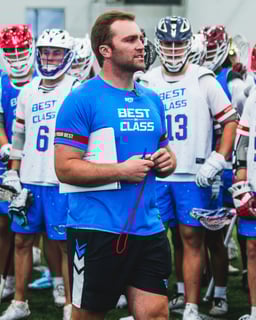

Good Morning!
Last week we released our podcast with Coach Conry, and a big theme that kept coming up was how we teach. Not just what drills we run, but how we structure learning so it actually shows up in games.
At the same time, we officially launched the Women’s Approach. Seeing the response to a defenders-only, teaching-focused environment has been really encouraging. It’s a good reminder that players and coaches are hungry for clarity, context, and coaching that goes beyond just cycling through reps.
This week’s thought ties those two things together. How we balance game-like reps with real instruction. How we teach details without losing the game. We love diving into these topics and encourage any thoughts or questions you have.
Stay warm and best of luck to those starting their seasons!
Let’s get into it. Happy Friday ☕️,
Matt & Deemer
Forwarded this email? You can subscribe here to stay in the loop 👍.
Featured Event: “The Approach” Women’s 2026
🚨 NOW LIVE 🚨

Built with Phil Barnes, the former defensive coordinator and recruiting director at North Carolina, The Approach is a college-level defensive environment designed to teach players how to actually play defense, not just cycle through drills.
We are committed to making this a first of its kind defensive event. It is intended to be immersive and interactive with a great staff of coaches focusing fully on playing defense in women’s lacrosse. This event is for women’s midfielders, defenders and goalies.
Matt Dunn, FCL Defense

✏️🍊 Blog: Syracuse’s 2026 College Preview
📧 Coaches Corner: Four Drills from BIC Women’s Committed
🎥 Instagram: Winter Showcase ASG Highlights

Kevin Conry: Building Michigan Lacrosse, Defensive Footwork, & The "Baby Giraffe" Theory


⭐️ Weekly Thought: Whole-Part-Whole Method
This past week, we released our podcast with Michigan Men’s Lacrosse Head Coach Kevin Conry. One topic that came up in the podcast was the Whole-Part-Whole method of teaching.
What is it?
The whole-part-whole method is a method of teaching where learners:
Are introduced to a skill or concept in its complete form
Practice or study its individual components
Return to the complete form to integrate and apply what they have learned
Rinse & repeat
How it is Used in Sports?
Lets break this down with an example. Let’s say we wanted to focus on shooting with your feet set from the 10-12 yard range.
Step 1: Game-Like Scenario
When designing drills, the goal isn’t to invent new situations, it’s to pull real ones out of the game and zoom in on them.
For example, in man-up offense it’s very common for defenses to guard three offensive players with two defenders up top. If we want players to get better at drawing one and forcing a rotation, we don’t need the entire man-up unit on the field. We can isolate just that moment and turn it into a 3v2 drill.
The purpose here isn’t “do 3v2s and then work on shooting.” It’s to take a specific action from the whole offense, isolate it, and drill it with intention.

Flat 3v2’s
In this drill setup, the blue lines would be boundaries (cones set up) that the players must stay inside of. The objective of this drill would be get a hands free step-down.
Offensive players could make use of drags, carries, stepping into the gaps, shallow cuts, and anything else that may commit a defender to the ball carrier, creating a two on one.
As a coach, you would be watching for things like catching it loaded, effective weight transfer when shooting, proper alignment before releasing a shot, stepping to the target, and minimal movement of your stick throughout the shooting motion.
Step 2: Break Down Individual Components
“One of the things we wanted to do, is we wanted to teach the actual proper footwork, technique, toes, hips, stick placement, all that stuff, and break it down like we were in Levittown, PAL, right? The first time you were going to touch a stick, or Baltimore Rec League, wherever you guys played.”
As Coach Conry said on the podcast, now we must break down the proper technique of the skill.
If we were focused on shooting mechanics, two great drills that achieve proper shooting form are the Spin and Fire Drill, and the Step Up Shooting Drill.
These remove defenders and decision-making so players can focus purely on executing the movement correctly.
Check out the beginning of our YouTube video for full explanations of these two drills:
Step 3: Return to Complete Form
After spending time isolating and refining the individual components of the shooting motion, the next step is to put those mechanics back into a game-like environment.
This can be done by returning to the same drill you started with, or by introducing another small-sided drill with similar constraints or even live play. In our case, any drill that limits players to step-down shots from range would reinforce the original objective.
From there, you could expand from 3v2 to 4v3 or 5v4 with the constraint that all shots must be taken outside of a specified zone.
The goal is to see whether the improved mechanics hold up once more defenders, decisions, and game pressure are reintroduced.
Benefits of this Teaching Method
This method allows players to get a feel for the whole skill first, which helps them see the importance. Starting with the full skill helps engage players early on in practice, capturing their attention for the instructional period.
By repeated effort covering the same skill, it reinforces understanding and retention for players. It allows players to transfer what they just learned right back into a game like scenario.
Wrapping Up
“I'm a big believer in the devils in the details, and the more detail oriented your footwork is in September, October, January, February, the more dialed in it was in May. And you don't have to do so much of it in May. You just kind of hit a couple refreshes, right?”
Coach Conry puts it best above. It is crucial to teach technique early in the year and early in the season. The more you introduce skills before players need them in games, the more time they have to retain, internalize, and apply that teaching under pressure.
By emphasizing details early, coaches avoid scrambling to “fix” fundamentals late in the season and instead can focus on refining, refreshing, and competing when it matters most.
FCL Thoughts - What About CLA & Ecological Dynamics?
The constraints-led approach and ecological dynamics have gained a lot of traction in recent years, and for good reason. They’ve pushed coaches to create better environments, stop over-prescribing, and think more intentionally about transfer. Skills don’t live in isolation. They show up in games, under pressure, with defenders, space, and timing all in play.
That thinking also challenged a lot of traditional part-to-whole coaching, and in many cases, the criticism is valid. Too often, skills were broken down, drilled in isolation, and never clearly reconnected to the game. Players learned movements, but not when or why to use them.
Whole–Part–Whole doesn’t have to be in conflict with those ideas. When done well, it actually depends on them. The skill starts and ends in a representative, game-like environment where perception and decision-making are intact. The brief breakdown in the middle isn’t meant to replace discovery. It’s there to temporarily simplify the environment so important details don’t get lost in the chaos. Step-up shooting may not fit a strict ecological framework, but it can be an effective way to clean up weight transfer and mechanics that don’t always emerge cleanly in live play.
The key is intention and timing. If the detail doesn’t show up when players return to the game, it doesn’t count. Whole–Part–Whole isn’t about choosing structure over chaos. It’s about sequencing them in a way that gives players clarity and allows skills to actually hold up when it matters.
Coach Class and Coach Dunn

Last weekend, we held our Men’s & Women’s Winter Showcases for 2028’s & 2029’s as well as our Men’s Committed at IMG Academy in Florida.

The backdrop for our BIC Committed game on Saturday evening!
The three events made for a competitive and collaborative environment down in Florida. Check out the ASG rosters for each age group for our Winter Showcase:
And for the Committed event, check out our MVP’s and Award Winners. These nine recipients will have the opportunity to partner with First Class Lacrosse and Best In Class for exclusive NIL experiences, including FCL brand partnerships, gear, gift cards, and more!
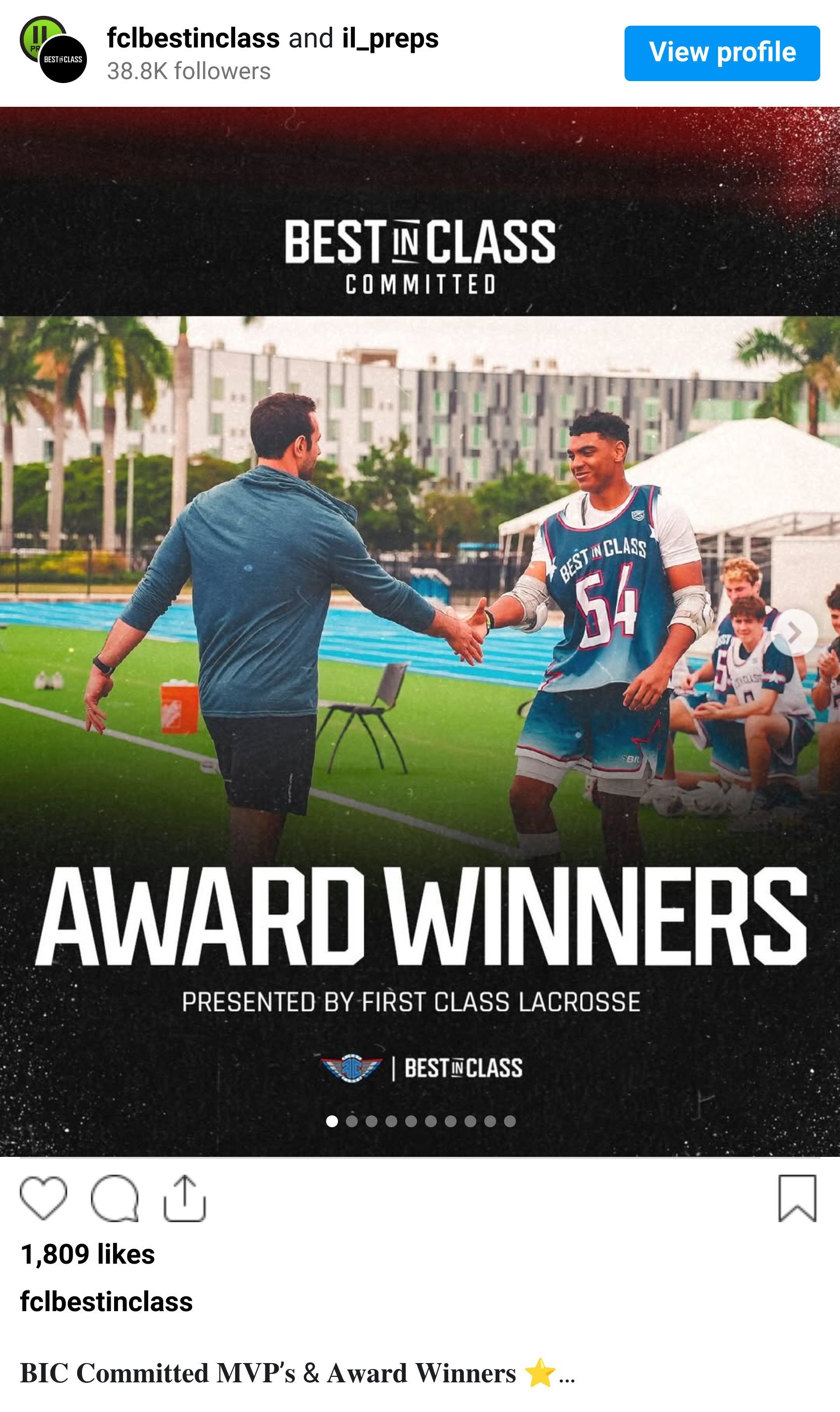
✅ Want to catch up on the action? Check out our @fclbestinclass Instagram page for the best highlights and moments from the event!
📈 WEEKLY THOUGHT SPONSORSHIP
Partner with FCL each Friday
Reach parents, players, and coaches at every level—from youth to pro—with a single Friday email.
The Weekly Thought is one of lacrosse’s most-read newsletters, delivering insights, tips, and stories to a rapidly growing global audience.
11,600+ subscribers (and growing weekly)
74% average open rate — more than 3x industry average
Read by parents, high school & college athletes, and coaches at all levels
Trusted source for lacrosse insights, training tips, and recruiting guidance
If you’re interested in reaching this highly engaged community, reply to this email or contact us at [email protected] for sponsorship opportunities